

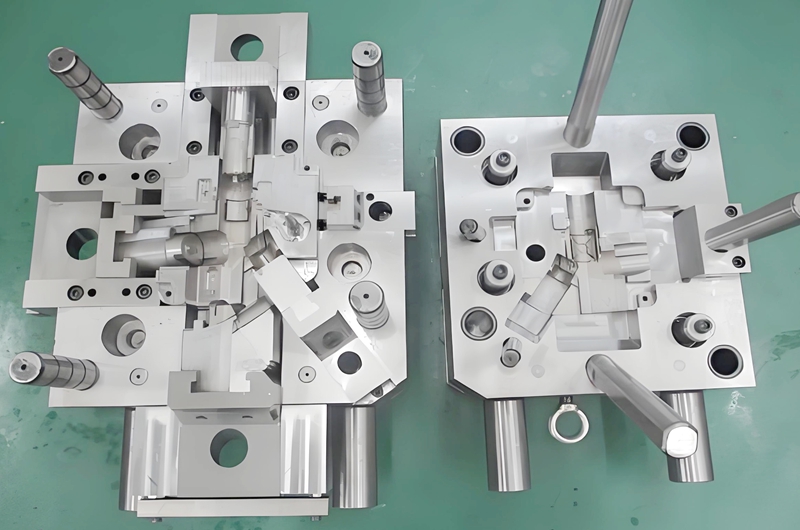
The forming components are the "matrix" within the mold that directly shape the plastic, imparting its dimensions and surface quality. These primarily refer to the Cavity and Core, whose design directly determines product accuracy, appearance, and successful ejection.
The core design principles are as follows:
Wall-Thickness Driven Design: The thickness of the forming components directly influences the uniformity of the product's wall thickness. The design must ensure sufficient rigidity (to prevent deformation under high pressure) while incorporating evenly distributed cooling channels for efficient heat transfer. This is crucial for controlling cycle time and warpage.
Precise Alignment: The core and cavity must have high-precision mating and alignment mechanisms (e.g., guide pins/bushings, tapered locks) to ensure accurate mold closing and prevent flash or inconsistent wall thickness on the part.
Surface Finishing: Based on product requirements, the forming surfaces undergo polishing (from grit paper to mirror finish), texturing (leather/geometric patterns), or coating (e.g., DLC, TiN). This affects not only appearance but also release performance and mold life.
Process Considerations:
Draft Angles: All forming surfaces must incorporate sufficient draft (typically ≥1°) to ensure smooth part ejection.
Fillet Transitions: All internal corners must use radii (R-fillets) to distribute stress, improve plastic flow, prevent cracking, and extend mold life.
Avoid Sharp Corners and Dead Zones: Sharp corners are stress concentrators and crack initiators; dead zones can trap gas and cause short shots.
Core Philosophy: Forming component design is an integration of structural strength, thermal management, precision manufacturing, and surface engineering. Excellent design significantly enhances production efficiency, product yield, and mold durability.